





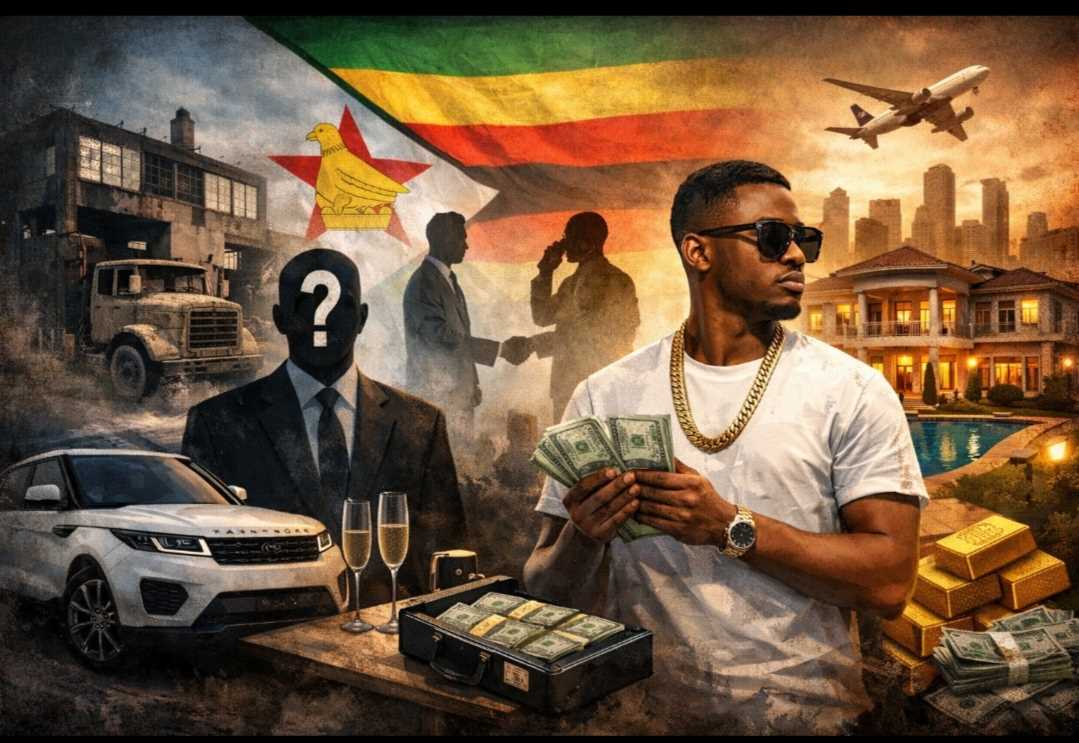
There was a time when wealth in Zimbabwe came with a story.
You knew who built what. You knew which family ran which business. You knew the grind behind the money — the factories, the farms, the transport fleets, the long, visible road from struggle to stability.
Today, the money is louder. The stories are quieter.
Or worse — they are missing entirely.
Spend enough time in Harare’s social spaces, and a pattern begins to emerge. New faces, new money, new titles. A young man pulls up in a top-of-the-range vehicle, steps out flanked by friends, and within minutes, someone will whisper: “He’s in business.”
What business?
A pause. A shrug.
“Deals.”
This is the new Zimbabwean archetype: the businessman with no business.
He is always in “projects,” perpetually closing something, always just back from somewhere — Dubai, South Africa, Tanzania — and yet never quite tied to a product, a service, or an enterprise you can point to. His office is his phone. His network is his currency. His balance sheet is his lifestyle.
In many cases, wealth is no longer built — it is accessed.
Part of the explanation lies in the structure of the economy itself.
Zimbabwe operates in a space where the informal often overshadows the formal, where opacity is not an exception but a feature. Money moves quickly, quietly, and often without the kind of documentation that would allow the public to trace its origins. Add to that a culture of tenders, middlemen, currency arbitrage, and politically adjacent opportunity, and you have an ecosystem where wealth can be accumulated without ever passing through the traditional markers of enterprise.
Not created — but positioned for.
Factories are no longer the only symbols of success. Neither are offices, storefronts, or even employees.
Now, access is enough.
But the economic explanation is only half the story.
The deeper shift is cultural.
Related Stories
We have begun to celebrate wealth without asking questions of it. The car is enough. The bottle is enough. The aesthetic of success has replaced the substance of it. Social media has accelerated this — turning consumption into currency and visibility into validation.
In this new order, the young are not necessarily aspiring to build — they are aspiring to arrive.
The journey is irrelevant. The destination is everything.
There is a cost to this.
When wealth detaches from work, from production, from value creation, it distorts the very idea of business. Genuine entrepreneurs — the ones building slowly, employing people, navigating regulation, reinvesting, surviving shocks — find themselves competing not just in the market, but in perception. Their steady growth looks unimpressive next to the theatrics of unexplained affluence.
And perception, increasingly, is everything.
Over time, this erodes trust. Not just in individuals but in the concept of business itself. If everyone is “in business,” but nothing tangible is being built, then what exactly are we calling business?
Perhaps the most unsettling part is how quickly this has been internalised.
Ask a young person today what they want to do, and the answers are telling. Not professions. Not trades. Not even industries.
Just a single, catch-all phrase: “I want to make money.”
Not earn. Not build. Not grow.
Just make.
Zimbabwe has always been a country of hustlers. That, in itself, is not new. What is new is the quiet disappearance of the story — the link between effort and outcome, between enterprise and reward.
We are becoming a country where wealth no longer needs to explain itself.
And when money no longer tells a story, it stops teaching anything at all.
It cannot show the way. It cannot be replicated. It cannot be trusted.
Because in the end, a society that celebrates outcomes without origins does not produce entrepreneurs.
It produces spectators… waiting for their turn at a miracle.
Simbarashe Namusi is a peace,leadership, and governance scholar as well as media expert writing in his personal capacity







Leave Comments