







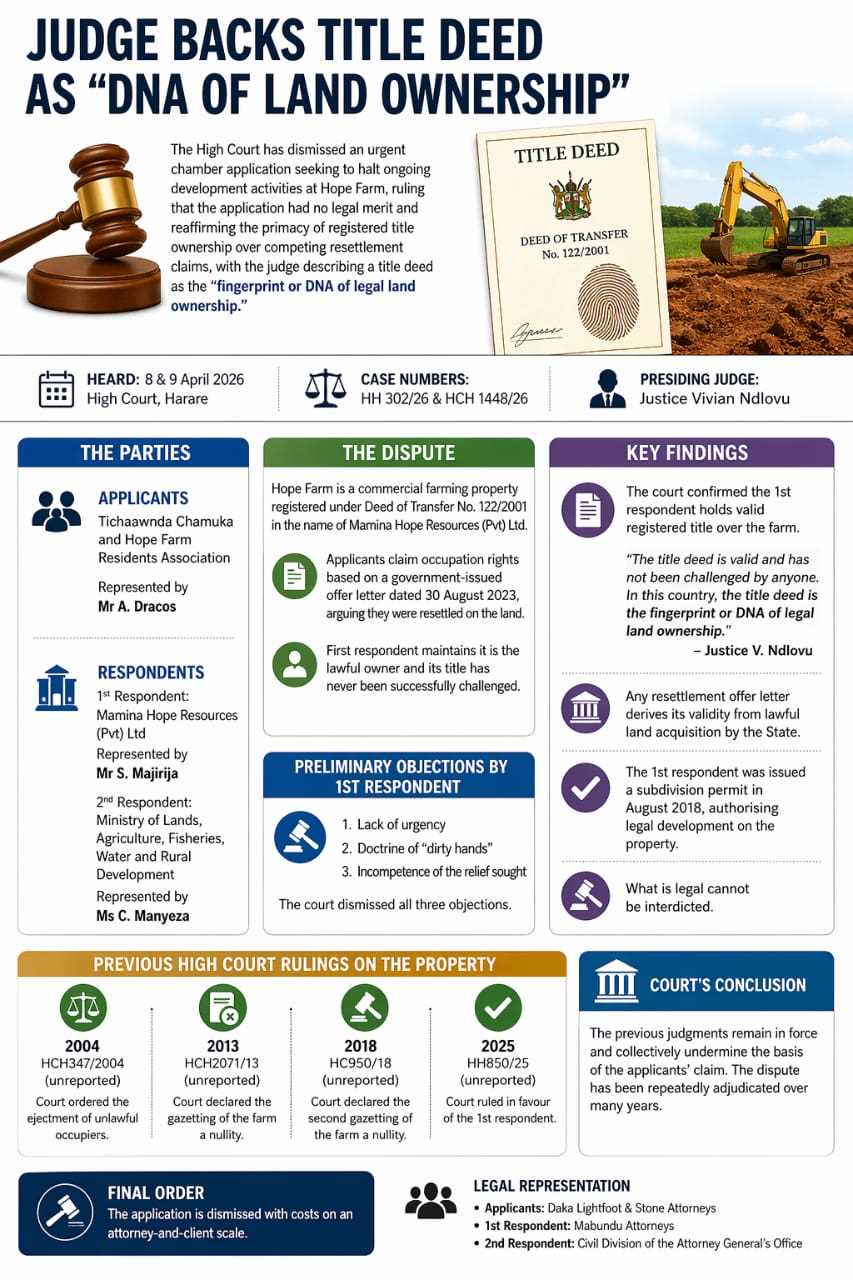
The High Court of Zimbabwe has dismissed an urgent chamber application seeking to stop development activities at Hope Farm, reaffirming the legal supremacy of registered title ownership over competing resettlement claims.
In a strongly worded ruling delivered in Harare on April 8 and 9, 2026, Justice Vivian Ndlovu described a title deed as the “fingerprint or DNA of legal land ownership,” underscoring the decisive weight courts attach to registered property rights.
The matter, heard under case numbers HH 302/26 and HCH 1448/26, involved Tichaawnda Chamuka and the Hope Farm Residents Association, who sought a provisional interdict against Mamina Hope Resources (Pvt) Ltd and the Ministry of Lands, Agriculture, Fisheries, Water and Rural Development.
The applicants argued that they were lawfully settled on the land through a government-issued offer letter dated August 30, 2023, and sought to halt development works initiated by the registered owner.
However, Mamina Hope Resources maintained that it remains the lawful owner of Hope Farm under Deed of Transfer No. 122/2001 and that its ownership had never been successfully challenged in court.
Court addresses preliminary objections
The first respondent raised three preliminary objections — lack of urgency, the doctrine of “dirty hands,” and the competence of the relief sought.
On urgency, Justice Ndlovu ruled that the application was properly filed after development machinery was brought onto the farm on March 13, 2026, marking the point at which the applicants’ cause of action arose.
The “dirty hands” argument — alleging that applicants had previously been evicted before reoccupying the land without a court order — was dismissed because it involved disputed facts tied to the substantive merits of the case.
The court also rejected objections relating to the form of interim relief, acknowledging that while provisional orders typically differ from final relief, deviations may be permitted depending on circumstances.
Title deed takes precedence
Related Stories
Turning to the merits, the court confirmed that Mamina Hope Resources holds valid registered title over Hope Farm.
“The title deed is valid and has not been challenged by anyone. In this country, the title deed is the fingerprint or DNA of legal land ownership,” Justice Ndlovu ruled.
The judge noted that the applicants’ reliance on a resettlement offer letter could not override an existing title deed, explaining that such letters derive their authority only from lawful State acquisition processes.
Long litigation history weighs against applicants
The judgment highlighted that Hope Farm has been the subject of multiple court decisions spanning more than two decades.
Previous rulings included a 2004 eviction order against unlawful occupiers, a 2013 judgment invalidating a gazetting process, a 2018 ruling nullifying a second acquisition attempt, and a 2025 decision reaffirming the first respondent’s legal position.
Justice Ndlovu held that these decisions remain binding and collectively weaken the applicants’ claim to occupation rights.
The court further noted that in August 2018, government authorities issued a subdivision permit authorising lawful development on the property.
“What is legal cannot be interdicted,” the judge said, adding that courts must uphold finality in litigation where disputes have already been conclusively determined.
Application dismissed with costs
Finding no legal basis for the relief sought, the High Court dismissed the urgent chamber application with costs on an attorney-and-client scale.
Legal representation was provided by Daka Lightfoot & Stone Attorneys for the applicants, Mabundu Attorneys for the first respondent, and the Attorney General’s Civil Division representing the Ministry of Lands.








Leave Comments