








Zimbabwe’s tobacco industry is racing toward another record-breaking season, but beneath the headline production figures lies growing anxiety across the sector as falling prices, weaker global demand and rising production costs squeeze farmers’ earnings.
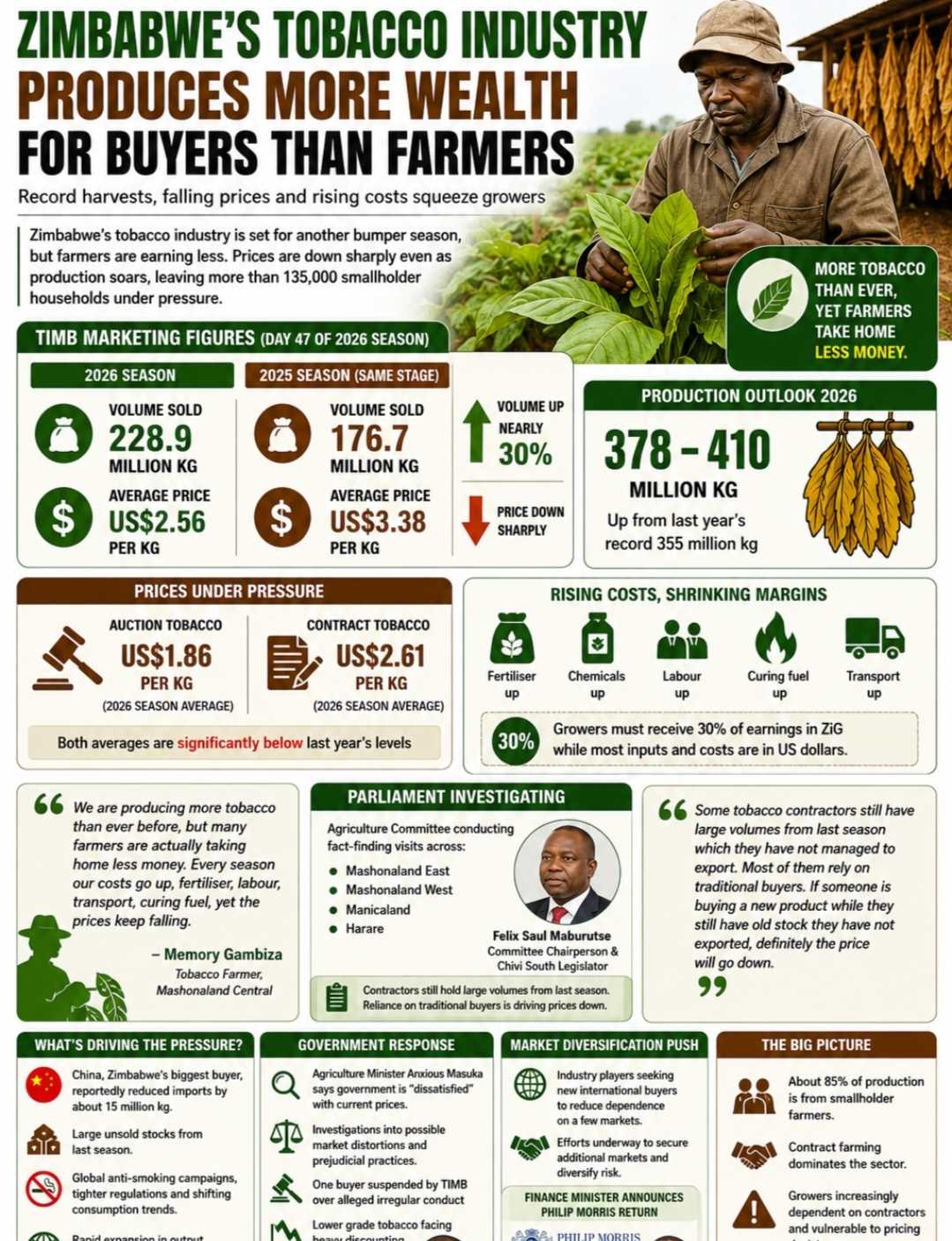
Latest figures from the Tobacco Industry and Marketing Board show that by Day 47 of the 2026 marketing season, growers had sold 228.9 million kilogrammes of tobacco at an average price of US$2.56 per kg. At the same stage last year, 176.7 million kg had been sold at a far stronger average price of US$3.38 per kg.
While volumes have surged by nearly 30 percent, prices have dropped sharply, leaving many growers earning less despite producing more.
The contrast has exposed deepening structural tensions within Zimbabwe’s largest agricultural export sector, which now supports more than 135,000 mainly smallholder farming households and contributes billions in export earnings annually.
Industry projections suggest tobacco production could reach between 378 million kg and 410 million kg this season, up from last year’s record 355 million kg harvest. Yet the rapid expansion in output is colliding with weakening international demand and mounting global oversupply concerns.
The pressure is already visible on the auction floors.
TIMB figures show auction tobacco has averaged just US$1.86 per kg this season, compared to US$2.61 per kg under contract arrangements. Combined average prices remain significantly below last year’s levels.
Growers say the decline has come at the worst possible time, with production costs continuing to rise sharply.
Fertiliser, chemicals, labour, curing fuel and transport costs have all increased, while farmers are also required to receive 30 percent of their earnings in ZiG despite most inputs and operational expenses being priced in United States dollars.
For many growers, the economics are becoming increasingly difficult.
“We are producing more tobacco than ever before, but many farmers are actually taking home less money. Every season our costs go up, fertiliser, labour, transport, curing fuel, yet the prices keep falling,” said Memory Gambiza a Tobacco farmer from Mashonaland Central
The committee has been conducting fact-finding visits across tobacco sales floors in Mashonaland East, Mashonaland West, Manicaland and Harare following widespread complaints over weak prices.
Committee chairman and Chivi South legislator Felix Saul Maburutse warned that Zimbabwe’s traditional export markets were no longer absorbing the country’s rapidly rising output volumes.
“What we have noticed is that some tobacco contractors still have large volumes from last season which they have not managed to export,” he said during a tour of the new Ethical Leaf Tobacco floors in Harare.
“Most of them have been relying on traditional buyers, which means we should encourage them to look for new buyers. If someone is buying a new product while they still have old stock they have not exported, definitely the price will go down.”
The industry’s dependence on a narrow export base has increasingly come under scrutiny, particularly as China, historically Zimbabwe’s largest tobacco buyer, has reportedly reduced imports by about 15 million kg.
China’s Tian Ze remains the largest buyer and financier of Zimbabwean tobacco, giving shifts in Chinese demand enormous influence over domestic pricing dynamics.
Related Stories
Industry officials say the market is also still carrying large unsold inventories following last year’s bumper crop, further weakening buying appetite.
Agriculture Minister Anxious Masuka this week openly acknowledged Government dissatisfaction with current prices, describing the situation as “insidious” and confirming investigations into possible market distortions.
“Clearly, the government is not happy, dissatisfied, just as growers are with the prices that are obtained on the auction floors,” he said.
Masuka revealed authorities were examining whether principal buyers, surrogates or other actors were engaging in practices prejudicial to farmers. He noted that TIMB had already suspended one buyer over alleged irregular conduct.
The minister also highlighted the widening gap between auction and contract prices, saying lower-grade tobacco was facing particularly heavy discounting.
Analysts say the pricing disparities reflect broader structural imbalances within the sector, where contract farming now dominates production and independent auction sales continue to weaken.
About 85 percent of Zimbabwe’s tobacco crop is now produced by smallholder farmers, many operating under contract schemes that provide inputs and financing in exchange for guaranteed deliveries.
While the model has expanded production dramatically over the past decade, critics argue it has also left growers heavily dependent on contractors and vulnerable to pricing decisions beyond their control.
Meanwhile, global anti-smoking campaigns, tighter tobacco regulations and shifting consumption trends are beginning to reshape international demand patterns, raising longer-term questions about Zimbabwe’s aggressive expansion strategy.
Despite this, the country continues to pursue higher output targets.
From 306,000 tonnes in 2024, production jumped to 355,000 tonnes in 2025, with planted hectarage increasing again this year by roughly 15 percent.
Authorities and industry executives insist the solution lies in diversifying export markets.
David Machingaidze, executive chairman of Ethical Holdings, said efforts were underway to secure additional international buyers.
“There is always a constant drive to open up new markets and effectively achieve diversification of risk where we are not completely dependent on just a few markets,” he said.
“In fact, we have gone out and secured additional markets which will go a long way towards ensuring that the tobacco we purchase is sold.”
In a potentially significant development, Finance Minister Mthuli Ncube recently announced the return of Philip Morris International to Zimbabwe after more than two decades away, describing the country as an “opportunity market” for the global tobacco giant.
The move could broaden the buyer base, though industry observers caution that new entrants alone may not immediately resolve pricing pressures caused by oversupply and weakening global demand.
For now, many farmers remain caught in a paradox: producing more tobacco than ever before, yet struggling to translate higher yields into stronger incomes.







Leave Comments